
Buyer guide
Why is my roller garage door not working?
Most roller garage door faults come from a few causes: no power, flat remote batteries, an obstruction or dirty photocells, a damaged safety edge, debris in the guides, or a worn motor. You can safely check the power, remote, guides and photocells yourself. If the door is crooked, out of its guides, or the motor hums without moving, stop using it and request a visit.
What should I check first when a roller door won't work?
Start with the simple, safe checks: the power supply, the remote, anything in the doorway, the photocells and the guides.
- Power. Is the fused spur or socket switched on, and is the fuse intact? Are other things in the garage working? Check for a power cut.
- Control box. Look for lights or a fault display on the wall control and note what it shows.
- Remote. Try the wall switch or keypad. If that works, the remote battery is the likely cause.
- Doorway. Check for anything under the bottom rail or across the photocell beam.
- Guides. Look along both guides for leaves, grit, ice or anything caught in them.
Never open the roller box, adjust the limits, touch the springs or try to pull a curtain back into its guides. Those jobs need an engineer.
Why won't my roller garage door open, or my remote work?
A door that won't open is most often down to no power, a flat remote battery, a lock or override left engaged, or something jamming the curtain.
If nothing happens from the remote but the wall switch works, change the remote battery and stand closer to the door. If the remote still doesn't work, it may have lost its pairing with the receiver, which can be recoded on a visit for £69–£119 inc VAT. If nothing works from any control, check the power and whether the control box shows a fault. On a manual door, check the bottom-rail lock is released. If the door is frozen to the floor in winter, don't force it; let it thaw.
Why does my roller door stop and go back up?
A door that stops and reverses on its way down is usually reacting to its safety devices, which think something is in the way.
Check under the bottom rail for debris, snow or a stone, and wipe the photocell lenses. Photocells can be knocked out of line by a bin or a car, so look at whether they still face each other. If the door still reverses, the safety edge on the bottom rail may be damaged, or there may be a wiring fault in its cable. Don't try to bypass a safety device. A replacement safety edge is £159–£295 inc VAT, and a photocell pair is £99–£189 inc VAT, both fitted.
Why does my door only close if I hold the button down?
If the door only closes while you hold the button, the control box has usually switched to hold-to-run mode because it has detected a fault with a safety device.
Hold-to-run lets you close the door under supervision while keeping you in control. It is a sign that something needs attention, often the safety edge, its cable or the photocells. Check the photocells and the bottom rail as above. If that doesn't clear it, use the door only while watching the whole opening, and request a visit. Our page on safety edge and photocell repairs explains what an engineer checks.
Why is my roller door noisy or closing crooked?
A noisy door usually has dirt or debris in the guides or a worn part, while a crooked or uneven curtain is a sign that something is catching or has slipped.
For noise, clean the guide channels with a damp cloth and remove any grit or leaves. Don't oil the guides unless the manufacturer says so, as oil attracts dirt. If the noise is a new grinding or knocking from the box, stop and book a check.
If the bottom rail is no longer level, the curtain is skewed, or a lath has bowed or come out of a guide, stop using the door straight away. Running a crooked curtain can tear laths and damage the guides and motor. Damaged laths can be replaced for £149–£395 inc VAT, see damaged lath repairs.
Why does the motor hum but the door doesn't move?
A motor that hums without moving the door may have a fault in the motor or its brake, or the curtain may be jammed, and you should stop pressing the button.
Repeatedly trying can overheat the motor. Tubular motors have thermal protection that cuts them out after heavy use, so a door that stops after several cycles in a row may simply need to cool down for a while. If it hums from the first press, or stops working regularly, it needs diagnosing. A replacement tubular motor, fitted and commissioned, is £395–£695 inc VAT, but an engineer will check first whether a repair is possible.
When should I stop and request a visit?
Stop using the door and request a visit if it's crooked, out of its guides, fails the safety test, makes grinding noises, or still won't work after the simple checks.
Keep everyone clear of the door, switch off its power at the spur, and don't walk or drive under a door that's part-open. A repair visit, covering diagnosis and the first 30 minutes, is £119–£169 inc VAT, with parts quoted before they're fitted. The visit price is agreed before we come out. See roller door repairs to request one.
Questions
Why has my roller garage door stopped halfway?
The door may have hit an obstruction, a safety device may have triggered, the motor may have cut out on its thermal protection after heavy use, or the curtain may have snagged in a guide. Check for obstructions and wait a while for the motor to cool. If the curtain looks crooked or stuck, switch off the power, keep clear and request a visit.
Can I reset my roller garage door motor myself?
Switching the power off at the spur for a minute and back on is a safe step, and some control boxes clear minor faults this way. Don't try to reset or adjust the motor's open and closed limits or the force settings yourself. Those settings control where the door stops and how hard it presses, and they need specialist tools and testing.
My remote stopped working after I changed the battery. What now?
Check the battery is the correct type and fitted the right way round, and that the contacts are clean. Try the remote close to the door. If it still doesn't work, it may have lost its pairing with the receiver. Some systems let you re-pair remotes by following the manufacturer's instructions; otherwise a recoding visit can sort it.
Related doors and services
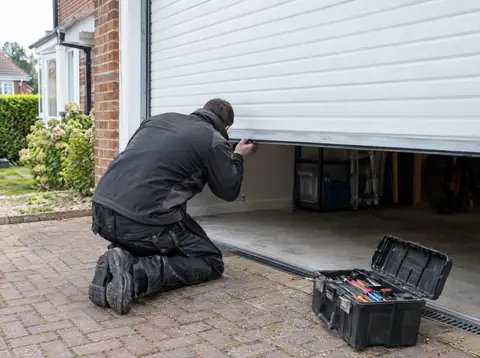 Roller garage door repairs
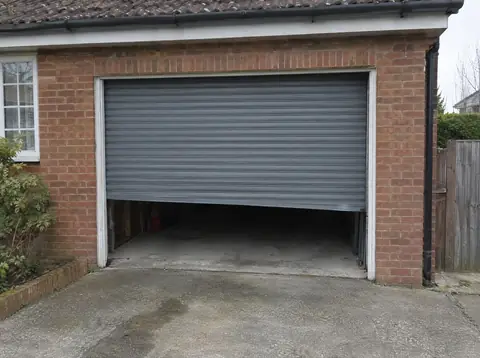 Stuck roller garage door repair
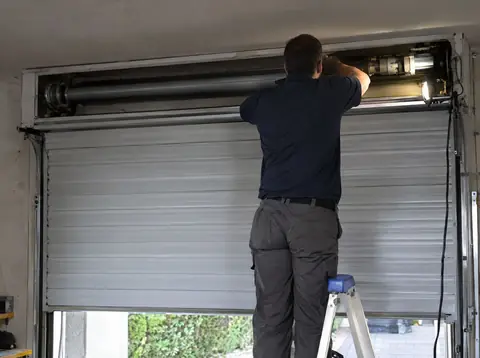 Roller garage door motor replacement
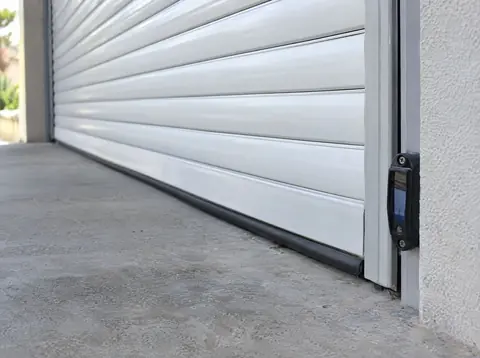 Safety edge and photocell repairs
More guides
Last reviewed 25 October 2026
Want a price for your garage?
Four questions, a guide price straight away.