
Buyer guide
How safe is an electric roller garage door, and how do I check it?
An electric roller garage door is protected by a safety edge on the bottom rail, photocells across the opening and force limits set during commissioning, so it stops or reverses if it meets an obstruction. The installer must test it to BS EN 12453 and hand over a Declaration of Conformity with UKCA or CE marking. Test it yourself monthly with a cardboard box in the doorway.
What safety devices does an electric roller door have?
An electric roller door relies on a pressure-sensitive safety edge, photocells and correctly set force limits to stop or reverse the door if something is in the way.
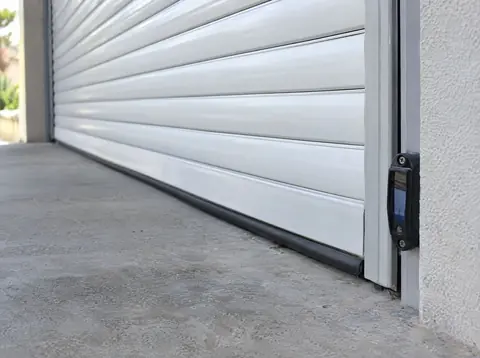
- Safety edge. A sensitive strip along the bottom rail. If it touches something while the door is closing, the control box stops the door and reverses it.
- Photocells. A pair of sensors fitted across the opening, near floor level. If the beam between them is broken while the door is closing, the door stops or reverses before it touches anything.
- Force limits. The force the door can exert is checked with a force meter at commissioning, so that if the door does make contact, it does so within safe limits.
- Limits. The motor's limits set the open and closed positions so the curtain stops in the right place each time.
Not every door uses both a safety edge and photocells. The combination depends on the door, the motor and the risk assessment carried out when it is put into service.
Which safety standards apply to powered garage doors?
Powered garage doors are covered by the product standard BS EN 13241, the safety-in-use standard BS EN 12453 and the Supply of Machinery (Safety) Regulations 2008, as amended.
BS EN 13241 sets out the performance and safety requirements for garage doors as products. BS EN 12453 deals with the safety of power-operated doors in use, including how the forces are measured and limited. Under the Supply of Machinery (Safety) Regulations, the person who puts a powered door into service is responsible for the risk assessment, the force testing, a Declaration of Conformity and the UKCA or CE marking. In Northern Ireland, CE marking applies.
We commission every powered door we fit to these standards and hand over the paperwork.
What paperwork should I get when a powered door is fitted?
You should get a Declaration of Conformity, a record of the commissioning and force tests, the UKCA or CE marking on the door, and the user instructions for the door and motor.
Keep these together with your quote and any manufacturer's warranty terms. They show the door was put into service properly and tell an engineer exactly what is fitted if it needs work later. If you buy a home with an electric roller door and there's no paperwork, a service visit is a sensible way to check the safety devices are working.
How do I safety-test my roller door each month?
Once a month, close the door onto a soft object such as an empty cardboard box and check that it stops or reverses as soon as it meets it.
- Open the door fully and make sure people, pets and the car are clear of the opening.
- Place an empty cardboard box in the doorway, under the centre of the curtain.
- Close the door with the remote or wall control while you watch from a safe position.
- The door should stop and reverse when the bottom rail touches the box, or stop before reaching it if photocells see it first.
- Repeat with the box near each side of the opening.
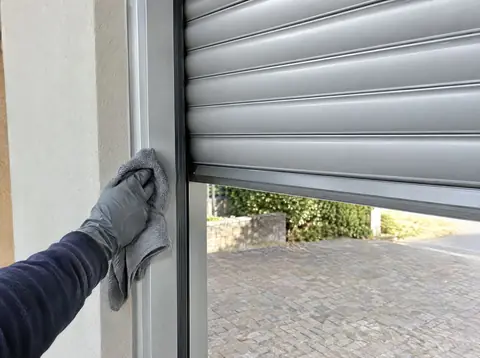
- Wipe the photocell lenses with a soft dry cloth and check nothing blocks the beam.
Only use an empty cardboard box for this test. Never use a hand, foot, person or pet.
How do I keep children and pets safe around a roller door?
Keep remotes out of reach, operate the door only when you can see the whole opening, and never let anyone walk or play under a moving door.
- Never walk, run or drive under a door that is moving or only partly open.
- Keep remote handsets away from children and don't let them use the wall control.
- Check the opening is clear before you press close, especially for small children and pets who move quickly.
- Don't hang anything from the bottom rail and don't let anyone ride on the curtain.
- If you use app control, be particularly careful when you can't see the door. Our smart control guide covers this.
What should I do if the safety test fails?
If the door doesn't stop or reverse on the box, stop using it electrically, keep everyone clear and request a visit.
The cause may be a damaged safety edge, a faulty or misaligned photocell, a wiring fault or a control box problem. Don't try to adjust the limits, force settings or the box yourself. A replacement safety edge, fitted, is £159–£295 inc VAT, and a replacement pair of photocells is £99–£189 inc VAT. The visit price is agreed before we come out. See our page on safety edge and photocell repairs.
Questions
Why does my roller door go back up when it nearly closes?
Usually because a safety device thinks something is in the way. Check for leaves, snow or debris under the bottom rail, wipe the photocell lenses and make sure nothing has knocked them out of line. If the door still reverses, the safety edge may be damaged or have a wiring fault. Don't try to bypass it; request a visit so an engineer can test and repair it.
Do I need a safety edge and photocells?
Every powered door needs protection against crushing, but the exact combination depends on the door, the motor and the risk assessment made when it is put into service. Many domestic roller doors use a safety edge on the bottom rail, and photocells add protection by stopping the door before it touches anything. At commissioning, force tests confirm the setup works within the limits set by BS EN 12453.
What is a Declaration of Conformity for a garage door?
It is a signed document from the person who put the powered door into service, stating that the complete door, as fitted and commissioned, meets the relevant requirements, including the Supply of Machinery (Safety) Regulations 2008. It goes with UKCA or CE marking on the door. Keep it with your instructions and commissioning record, as it's useful if you sell the house or need an engineer later.
Related doors and services
 Safety edge and photocell repairs
 Battery backup and safety upgrades
 Roller garage door servicing
 Electric roller garage doors
More guides
Last reviewed 25 October 2026
Want a price for your garage?
Four questions, a guide price straight away.