
Buyer guide
How do I measure my garage for a roller door?
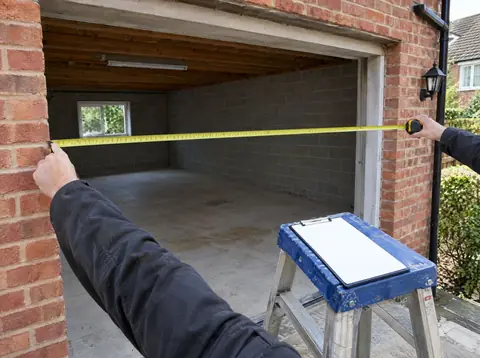
Measure the width between the brick reveals and the height from floor to the underside of the lintel, each in three places, and use the smallest figures. Then measure the headroom above the opening for the roller box, the side room inside for the guides, and note the floor level and the nearest power supply. Your figures give a guide price; we measure properly at the free survey.
What do I need to measure for a roller garage door?
You need seven things for a guide price: the width, the height, the headroom for the box, the side room for the guides, the depth inside, the floor level and where the power is.
| Measurement | Where to measure | Typical allowance |
|---|---|---|
| Width | Between the brick reveals at the top, middle and bottom | Use the smallest figure |
| Height | Floor to the underside of the lintel, at both sides and the middle | Use the smallest figure |
| Headroom | Underside of the lintel to the ceiling, or to the first obstruction inside | The box needs roughly 205 to 300 mm or more |
| Side room | Edge of the opening to the nearest wall or obstruction inside, each side | About 75 to 100 mm each side for the guides |
| Depth | Inside face of the front wall back to anything above the opening, such as a beam, light or pipe | Enough clear space for the box to sit behind the lintel |
| Floor level | Across the opening at floor level | Note any slope or step |
| Power | The nearest socket or fused spur to the top corner of the opening | Needed for an electric door |
How do I measure the width and height correctly?
Measure the width between the brick reveals and the height from the floor to the underside of the lintel, take each in three places and write down the smallest.
Openings are rarely perfectly square. Brickwork can lean, a lintel can sag slightly and floors often slope towards the drive. Measuring at the top, middle and bottom for width, and at the left, centre and right for height, shows up any difference. If you're replacing an up-and-over door, measure between the bricks, not between the old frame, because the frame normally comes out.
Use a steel tape and work in millimetres. A second person holding the end of the tape makes it much easier.
How much headroom does a roller door box need?
A roller box for a domestic door is commonly around 205 to 300 mm or more, depending on the door height and the lath size.
A taller door makes a bigger coil, and 77 mm laths coil larger than 55 mm laths, so the box grows with both. Measure from the underside of the lintel up to the ceiling, then look for anything in the way: joists, beams, pipes, cables, lights or the tracks of an old up-and-over door. If there isn't enough headroom, there are still options, which our page on low-headroom roller doors explains.
Where can the box and guides be fitted?
A roller door can be fitted behind the opening, between the reveals or face-fixed on the front of the wall, and behind the opening is the most common.
- Behind the opening. The box sits inside, behind the lintel, and the guides fix to the inside of the wall. You keep the full opening height and the box is hidden from the drive. This needs headroom and side room inside.
- Between the reveals. The guides fix inside the opening and the box sits under the lintel. It works when there's no room inside, but it reduces the clear opening width and height.
- Face-fixed. The box and guides fix to the front of the wall. It keeps the full opening and suits garages with no room inside, but the box is visible, so a matching colour helps.
What if my floor isn't level or there's no power?
A sloping floor and a garage with no power are both common and both solvable, but note them down because they affect the price and the fitting.
The bottom rail of a roller door has a rubber seal that copes with small dips. A noticeable slope or a step across the opening may need the floor levelling locally or the bottom of the curtain setting to suit, which we check at the survey.
An electric door needs a power supply near the box, usually a fused spur or a socket. If there's nothing near the top corner of the opening, a new fused spur can be fitted by an electrician for £129–£249 inc VAT.
Do I need to measure accurately before the survey?
No, your measurements only need to be close enough for a guide price, because we measure everything properly at the free survey before anything is ordered.
Your figures let our guide price tool show the right width band. At the survey we measure the opening again, check the lintel, headroom, side room, floor and power, and confirm the fitting position and box size. The written quote is based on our measurements, not yours, and roller doors are made to the size we take.
Questions
Should I measure the opening or the old door?
Measure the opening. Take the width between the brick reveals and the height from the floor to the underside of the lintel, not the size of the old door or its frame. Old up-and-over frames are normally removed, and the new roller door is sized to the brickwork. If you can't see the brick behind a frame, measure inside the frame and tell us it's there.
What happens if I measure wrongly?
Nothing goes wrong, because your measurements are only used for a guide price. Before a new door is ordered we measure the opening ourselves at the free survey, check the headroom, side room, lintel, floor level and power, and base the written quote on our figures. If the size band changes, the written quote shows the correct price before you agree to anything.
Can a roller door fit if there's no room inside the garage?
Often, yes. If there isn't enough headroom or side room inside, the box and guides can be face-fixed on the front of the wall, which keeps the full opening. Another option is fitting between the reveals with the box under the lintel, which reduces the clear opening. We check both at the survey and explain the trade-offs before you choose.
Related doors and services
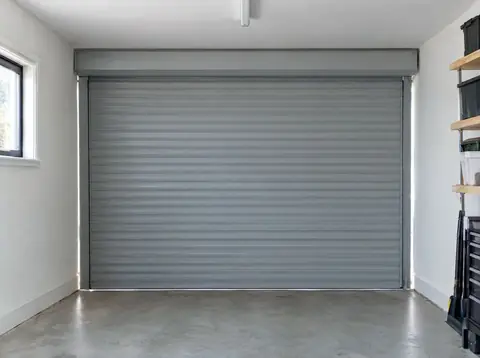
 Made-to-measure roller garage doors
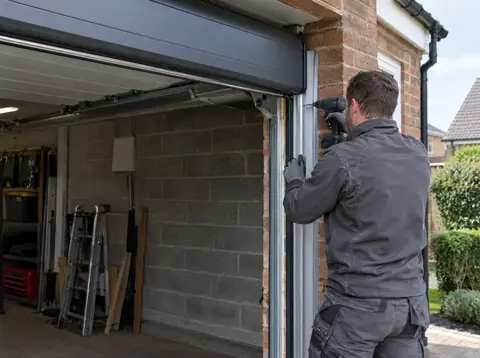 Roller garage door installation
 Low-headroom roller garage doors
More guides
Last reviewed 25 October 2026
Want a price for your garage?
Four questions, a guide price straight away.